A common management challenge is setting goals for engineers who either do not know what they want or actively dislike the goal setting process because it feels artificial, pressurising, or disconnected from how they actually grow.
In most cases, this resistance isn’t a lack of ambition, but it’s a reaction to how goals are usually imposed.
The Challenge
- Some engineers lack clarity on what they want or what is possible within the organisation.
- Are not familiar with career paths, roles, or opportunities, or how their strengths translate into options.
- Some people are not motivated by goals at all and react negatively to deadlines and formality. This resistance is often emotional or cognitive, not a lack of ambition.
After watching a talk by Alicia Collymore on this topic, I was inspired to try a similar approach with my direct reports. While the fundamentals are similar, I adapted the approach to fit my context and team.
The results were positive: we were able to define meaningful goals, with engineers leading the conversation rather than reacting to it.
Discover → Connect → Focus Framework
To address this, I use a visual, exploratory, and iterative framework that reframes goals as direction rather than obligation.
Discover
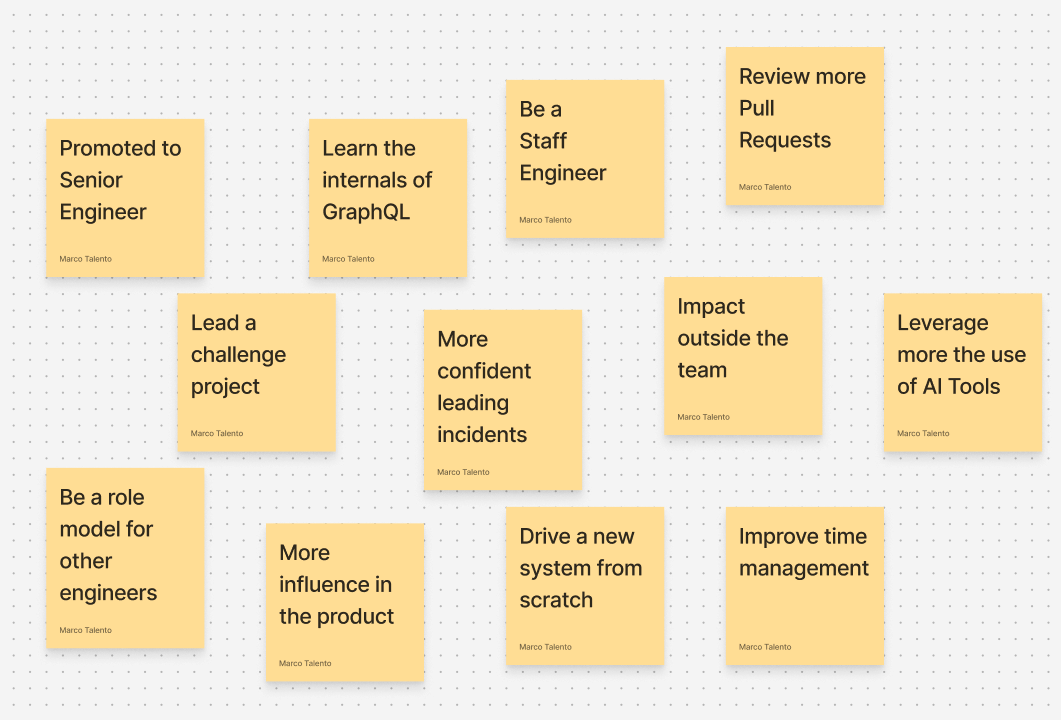
Use a tool like Miro, Figma, or sticky notes, and ask the engineer to write down anything they care about or are curious about across short, mid, and long-term goals.
- Extract ideas without judgement.
- Encourage big and small thinking, professional and personal:
- Career aspirations (e.g. Staff Engineer, CTO)
- Skill improvements (e.g. API Design, React internals)
- Personal life goals (travel, family, lifestyle business)
- Managers should help during this process to seed ideas using:
- Past conversations during 1:1s
- Organisational direction and needs
- Feedback from performance reviews
Topics for questions
Daily Friction: Often, the best goals come from things that annoy us. This helps engineers identify process or technical improvements.
- What is one part of our codebase or workflow that makes you sigh every time you have to touch it?
- If you had a ‘magic wand’ and could automate one manual task you did this week, what would it be?
- What’s a technical ‘debt’ item that you think is slowing the whole team down, not just you?
Levelling guide: Use the job level framework as a tool, but break it down into habits.
- If we look at the next level’s expectations, which of those behaviours feels like it would be the most ‘unnatural’ or difficult for you right now?
- Who in the company is currently at that next level and does something you really admire? What is that specific thing?
- Promotion is about ‘sustained performance.’ What is one thing you’ve done once (like a great architectural doc) that you’d like to be able to do consistently every month?
Curiosity: These help surface interests that aren’t tied to their current ticket backlog.
- Is there a specific technology or tool being used in another team that you’ve been curious about but haven’t had an excuse to look at?
- if you were to give a 10-minute ‘lightning talk’ to the team next month, what topic would you feel most confident (or most excited) to talk about?
Impact: Connecting them to the product/user makes them feel more “real.”
- Outside of writing code, what do you think is the biggest challenge our users or partners are facing right now?
- What’s one thing you think we (as a team) are missing when we plan our sprints?
- If you were the Product Manager for a week, what’s the first small feature you’d prioritise?
At the end of this phase, you will have many sticky notes with ideas that need to be connected.
Connect
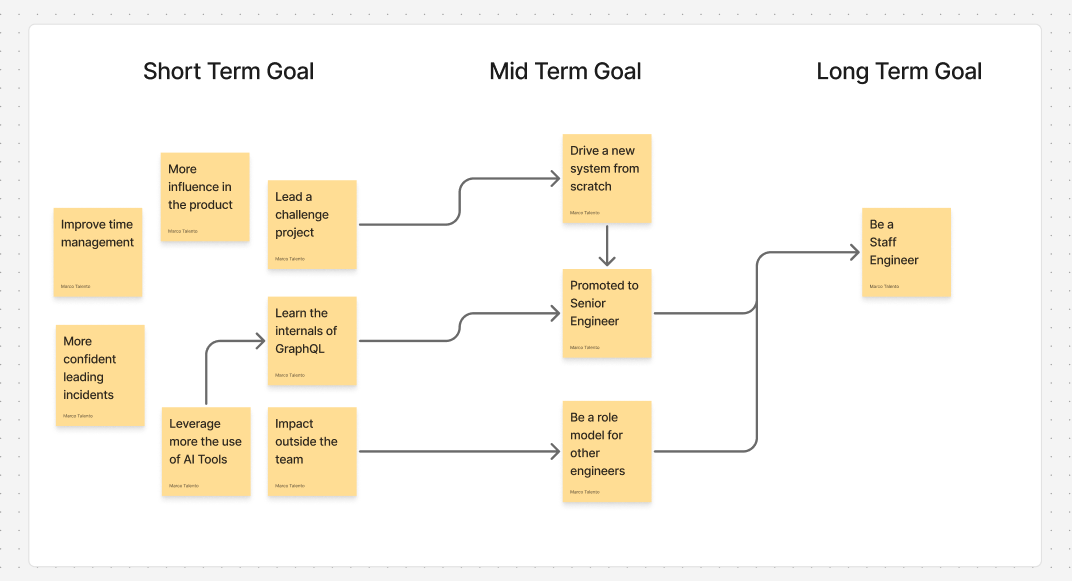
Now it’s time to connect all the ideas in a timeline and create a direction to show progression.
- Organise ideas into 3 different timelines:
- Short-term (3–6 months)
- Medium-term (6–12 months)
- Long-term (future / aspirational)
- Connect ideas to show progression:
- Small skills → bigger responsibilities → long-term roles
When connecting ideas, people often realise how things are connected and how meaningful they are to their goals, without feeling obligated.
Focus
The last step of the framework is to choose 2 to 3 ideas and turn them into actionable goals using a goal framework such as SMART or OKRs.
In the example below, we created two actionable goals:
- Read the “Production Ready GraphQL” book and share the learnings with the team by the end of Q3.
- Pitch a new feature to the product manager, explaining the benefits and engineering effort by end the of Q2.
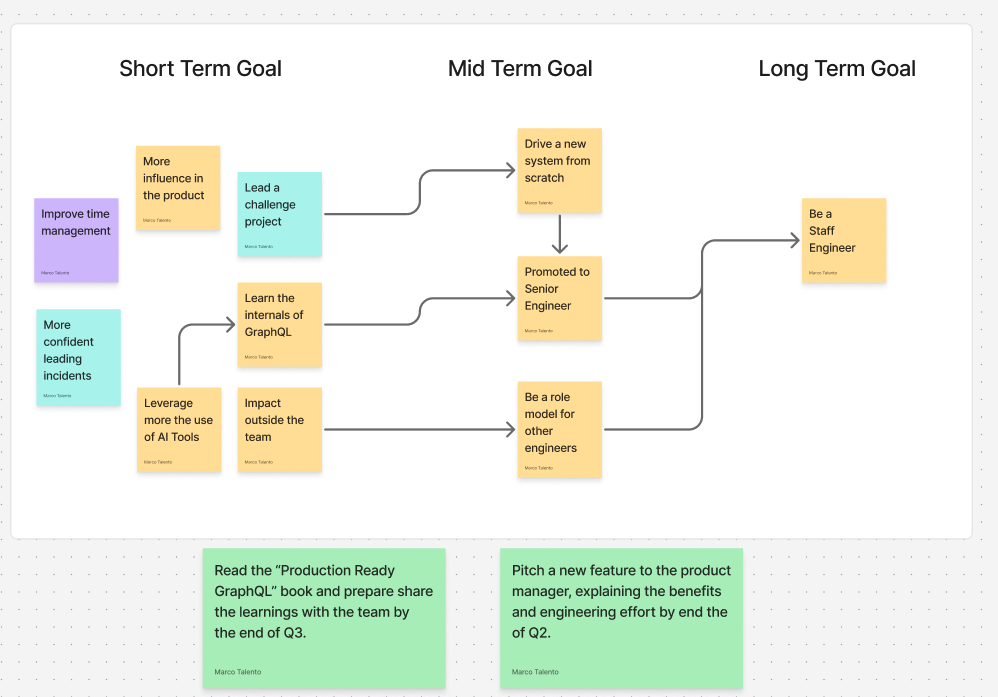
Some ideas shouldn’t be goals since the engineer does not have control over them, or are vague to be considered a goal:
- Focus Areas: Ideas that are hard to materialise in a goal like “improving time management”. These focus areas should be revisited regularly during 1:1s and review conversations.
- Opportunity based goal: Ideas where it depends on an opportunity and need advocacy from their manager. For example, leading a challenging project require advocacy from their manager, or depend on circumstances outside the engineer’s control (e.g. an incident occurring).
Review & Repeat
After running the framework and having 2 to 3 goals, the manager is responsible for regularly reviewing the progress and supporting their engineers to maximise their success.
This is a continuous process that should be repeated every quarter to set the direction for the engineers and maintain a healthy backlog of ideas.
At the end of the process, you must have:
- 2 to 3 clear, realistic goals
- A shared understanding of career direction
- Visibility into personal motivations
- A backlog of future goals to reuse and refine
- Actively create or surface opportunities aligned with opportunity-based goals
- Engineers who feel ownership and excitement, not pressure
Goal-setting often fails not because engineers lack ambition, but because the process asks for commitment before clarity. When goals are imposed too early, they feel artificial, pressurising, and disconnected from how people actually grow.
The Discover → Connect → Focus framework flips that dynamic. It starts with exploration, builds meaning through connection, and only then narrows attention to what matters now. By treating goals as an optional output rather than a mandatory input, the framework reduces anxiety, increases ownership, and creates more honest conversations about growth.
Most importantly, it acknowledges a simple truth: career development is not linear. People change, organisations evolve, and opportunities appear unexpectedly. A good goal-setting process should adapt to that reality, not fight it.
When engineers feel they are choosing the direction rather than being measured against it, goal-setting stops being a chore and becomes a useful tool.